You've Always Assumed Asking AI a Question Was Free. This Year, Your Power Bill Quietly Started Disagreeing
AI chatbots feel free and placeless, but the data centers behind them need staggering amounts of electricity. Here's what the growing strain on the power grid means for your bill, your town, and a small habit worth building.
For the last couple of years, "AI" has felt like something that lives nowhere in particular. You type a question into your phone, an answer comes back in a second or two, and that's the whole transaction. No wires, no smoke, no sense that anything physical just happened. It feels closer to magic than to electricity.
It isn't magic. Every one of those answers is produced by a building somewhere, full of racks of computers, running hot enough that it needs its own cooling system just to survive the day. And this year, for the first time, a lot of ordinary people started noticing those buildings exist — not because they read about them, but because their power bill went up.
In the US, average electricity prices have climbed somewhere between 10 and 13 percent over the past few years. Utilities point to extreme weather and fuel costs, which is true. But a growing part of that story is the sheer amount of electricity these AI data centers now need, and it's not a small or temporary amount. Research from S&P Global found that by the end of last year, data centers needed 22 percent more power than the year before. By 2030, they're expected to need almost three times what they use today. That's not a gentle slope. That's a cliff.
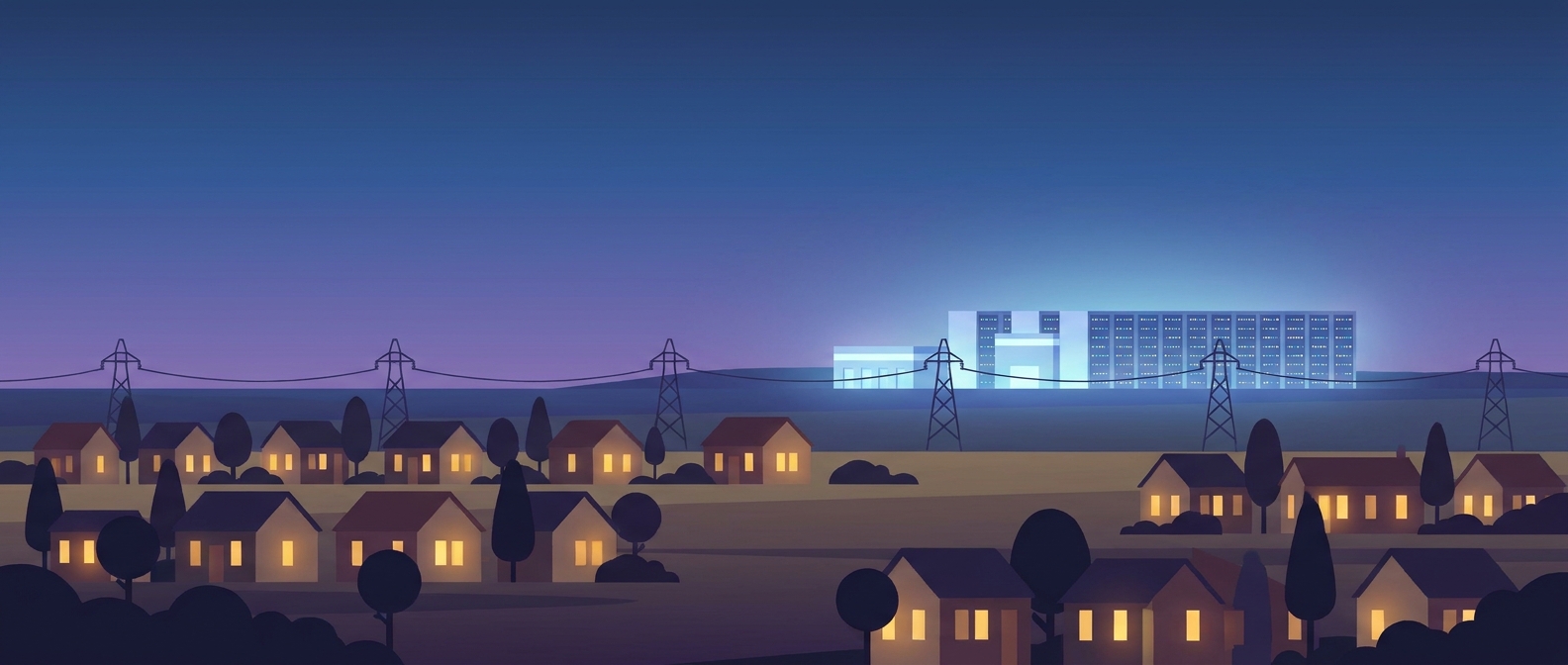
It got serious enough that a handful of US senators opened an inquiry this year into whether big tech companies are quietly passing the cost of their AI buildout onto regular households through their power bills. Their argument, in plain terms: when a data center the size of a small neighborhood shows up and needs as much electricity as a small neighborhood, somebody has to pay to upgrade the wires, the substations, and the power plants that make that possible — and right now, that somebody is often you, whether or not you've ever opened an AI chatbot in your life.
And the strange part is, this isn't just a story about bills creeping up. In some places, there simply isn't enough electricity to go around, full stop. Google canceled a planned data center near Berlin partly because it couldn't get access to enough power. A data center in Frankfurt can't expand because the local utility says it won't have the capacity until 2033 — that's not a typo, that's seven years from now. In Santa Clara, California, a facility that one company applied to build back in 2019 may sit empty for years because the grid can't feed it. Microsoft has started shifting investment away from Ireland and the UK toward the Nordic countries, essentially chasing spare electricity the way companies once chased cheap labor.
Think about that for a second. Some of the most well-funded companies on earth, building the most advanced technology of our time, are being told "no, not here, we don't have the power for that." The bottleneck for the future of AI isn't chips or clever engineers anymore. It's the same aging poles and wires that have carried electricity to our homes for decades.
The good news is that smart people are already working on it, and not just by building more power plants. One company I came across, Veir, has built superconducting cables that can carry power five times farther than ordinary ones while taking up a fraction of the space, and investors just handed them $110 million to scale it up. Another, WeaveGrid, builds software that helps utilities juggle all the new demand — data centers, electric cars, heat pumps — so the existing grid stretches further instead of needing to be torn up and rebuilt. There's even serious talk of nuclear-powered data centers on federal land, and, in the more far-out corner of the conversation, data centers in orbit, cooled by the vacuum of space. I wouldn't bet the farm on that last one yet, but a few years ago I wouldn't have bet on any of this either.
Here's what I keep coming back to: for all the talk about AI taking jobs or changing how we work, the thing most likely to touch your life first might just be a slightly higher number on next month's electricity bill. That's not a reason to panic, and it's definitely not a reason to feel guilty every time you ask a chatbot a question. It's just a reason to be a little more awake to how connected everything has become. The cloud has a cord plugged into the wall, just like the rest of us.
So here's a small aspiration worth picking up, and it costs nothing: once in a while, when you use something powered by AI, get curious about where that power actually comes from. Ask who's building near you, what it's doing to your town's grid, whether your local utility is being upfront about it. You don't need to become an energy expert. You just need to stop treating "the cloud" as a place with no address. The people making decisions about all this electricity are counting on most of us never asking. Being the kind of person who asks anyway — about AI, about the infrastructure behind it, about anything that's reshaping your world quietly in the background — is a habit that will serve you a lot longer than any single piece of technology will.
Steve Nyanumba
Building software for Kenyan and African businesses at Vapor Technologies.
Building something for your business?
We help Kenyan and African businesses ship software that performs.