Putting The Alps Hotel on the internet for the first time.
How a WordPress build from scratch gave a Nakuru hospitality brand its first real digital presence — and what that process taught me about building for clients who have never had a website before.
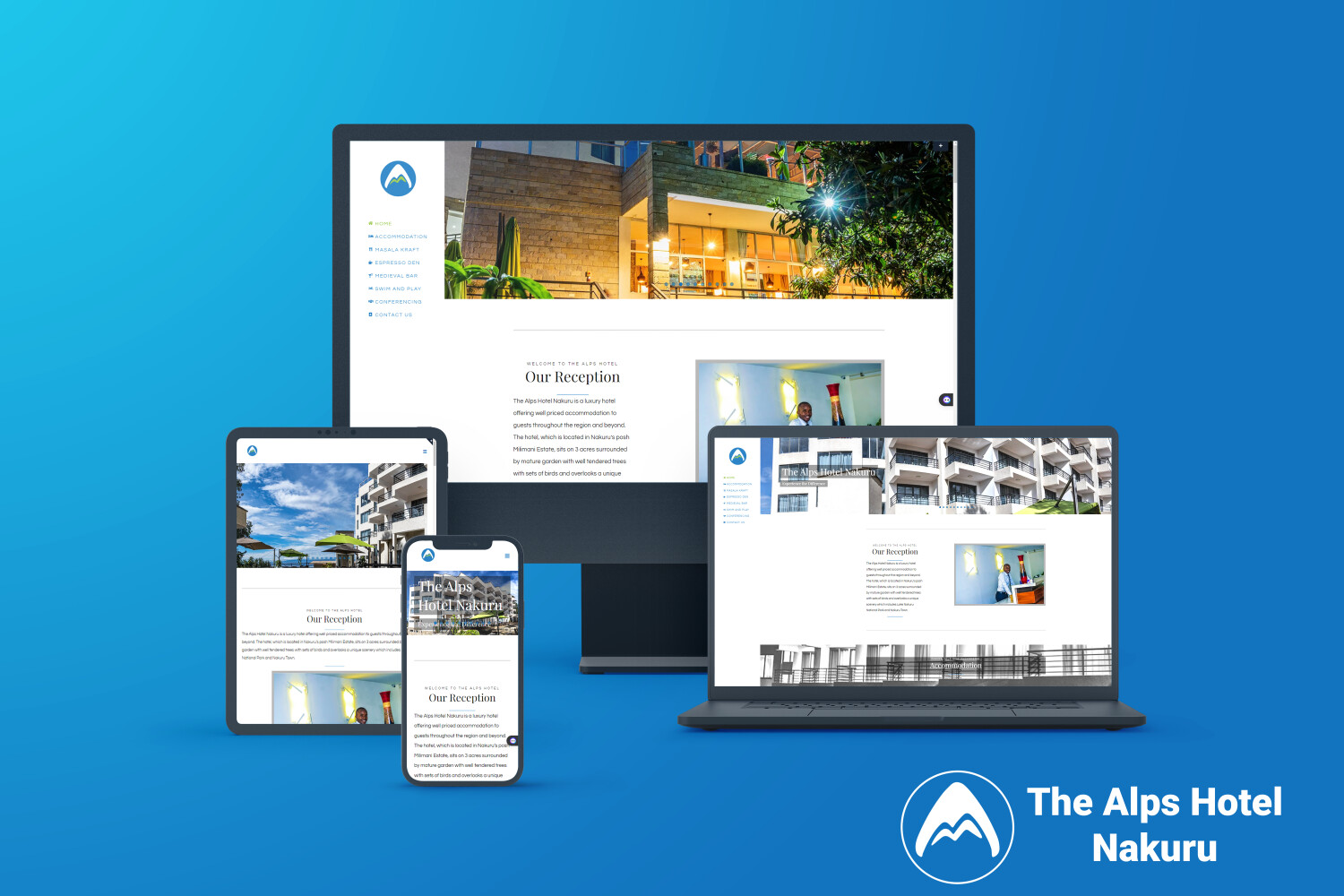
01 — The Brief
A hotel with rooms, reputation, and no website.
The Alps Hotel Nakuru was already running a real business. Guests were checking in, events were being hosted, and the hospitality was genuinely good. What they didn't have was a front door on the internet — not even a single page.
At the time, this was one of my earlier agency engagements, and it was exactly the kind of project I gravitated toward: a business with something worth showing, that just needed someone to build the showcase. They came to me with no brief, no brand guide, and no existing assets. Just a name, a location, and a mandate to get them online.
"They had a real product. My job was to make the internet agree."
The constraint was also the clarity: start from zero, define the presence, and ship something the team could actually manage themselves going forward. That meant choosing a stack that balanced polish with maintainability.
02 — The Stack
WordPress and Avada — picked deliberately, not by default.
I chose WordPress with the Avada theme not because it was the easy answer, but because it was the right one for this client context. A hotel team isn't a development team. They need to update room listings, swap a cover photo, or post a special offer — without calling anyone.
Avada's Fusion Builder gave me the layout control to build something that didn't look template-generic, while keeping the editing interface intuitive enough that the hotel's team could take ownership post-handoff. The goal was always a product that outlives the project.
I handled all the initial content architecture — deciding how many pages, what the navigation hierarchy looks like, which rooms get individual pages versus grouped listings, and how the contact and booking touchpoints would be structured.
03 — The Challenges
Building a presence from nothing is a specific kind of hard.
There's a popular assumption that "small" projects are simple projects. Starting from zero is, in many ways, harder than inheriting something broken. There are no reference points, no prior decisions to anchor from, and the client often doesn't know what they want until they see something they don't want.
▶Zero source assets. No professional photography, no brand colors, no existing logo files. I sourced imagery, established a visual language, and kept it coherent across the build.
▶Content definition. Writing didn't exist. I structured and authored the core copy across all pages — rooms, facilities, about, and contact — anchored to the hotel's actual offering.
▶Client education. First-time website owners need onboarding, not just a handoff. I built the site and explained the internet to them at the same time.
▶Scope without a scope. No brief means negotiating scope as you go. That's a skill, and it's one I refined sharply on this engagement.
04 — The Outcomes
From invisible to indexed, in a single engagement.
The site shipped complete — all pages, functional contact form, mobile responsive, and configured for search indexing. The hotel went from having no digital presence whatsoever to having a structured, navigable website that could be found on Google.
0 → 1
Website built entirely from scratch, no prior digital presence
100%
Client team able to self-manage content post-handoff
Full
SEO setup, sitemap, and Google indexing configured at launch
Beyond the deliverable, this project sharpened how I approach hospitality clients specifically: the emphasis on atmosphere over information density, the importance of a strong hero, and why booking-adjacent calls to action need to be accessible from every page.
They're on their second website now. I'm building that one too — apparently I didn't do a bad enough job the first time.
05 — The Lesson
First websites are foundational. Treat them that way.
A business's first website is more than a digital brochure. It's the moment they start to exist on the internet — for their customers, for search engines, and for their own sense of professional legitimacy. That weight deserves more than a template drag-and-drop.
What I brought to The Alps Hotel was structure, taste, and the discipline to make decisions confidently when no brief existed. That's the work. The code is almost incidental.
If you're running a hospitality, logistics, healthcare, or services business in Kenya and you're still not online — or you're online but embarrassed by what's there — that's exactly the kind of problem I solve at Vapor Technologies.
We didn't know what we needed, we just knew we needed to be online. Steve Nyanumba of Vapor Technologies came in, asked the right questions, and delivered a site we were proud to share with guests. Professional, patient, and he got it done. We've worked with him again since — that tells you everything.
 ManagementThe Alps Hotel Nakuru