You've Always Fought for the Click. This Year, Winning a Customer Quietly Stopped Needing One
For twenty years, winning a customer online meant winning a click. This year, AI started giving people the whole answer before they ever reached your website — and most business owners haven't noticed the shift yet.
For as long as most of us have had a business online, the game was simple. Someone had a problem, they typed it into Google, a page of blue links came back, and if your website was one of the first few, you had a shot. You wrote a blog post, you fixed your meta description, you begged for a backlink, all so that when someone searched "best hotel in Nakuru" or "payroll software Kenya," your link was the one they clicked.
That was the whole deal for about two decades. Google sent you the visitor, and what you did with that visitor was your problem to solve.
This year, quietly, that deal has been changing.
The answer is showing up before the click
More and more, when someone asks a question online, whether through Google's AI Overviews, ChatGPT, or Perplexity, they are getting a full answer right there on the screen. No scrolling. No comparing five tabs. No visiting your site to confirm the thing the snippet already told them. Industry research this year has put the share of Google searches that end without a single click anywhere close to 60 percent, and that number keeps climbing every time AI gets better at summarising.
I want you to sit with that for a second if you run a business. Six in ten people who search for something close to what you sell may never see your website at all, not because you ranked badly, but because they didn't need to click anything to get their answer.
Some researchers have started calling this "Google Zero." Not because Google is going away, but because the old contract, rank well and get traffic, is no longer the whole story. You can be the actual source of the answer the AI gives someone, and still get zero visitors for it.
Why this matters more here, not less
I know it's tempting to file this under "big international company problem." It isn't. If you run a clinic, a boutique hotel, a school, a logistics firm, anything that depends on someone finding you online before they call or walk in, this change reaches you too. A parent in Nairobi asking an AI assistant "which schools near me offer a British curriculum" is making a shortlisting decision right there in the chat. A traveller asking "quiet garden venue for a small wedding in Nakuru" is doing the same thing. If the AI doesn't know enough about you to mention you in that answer, you were never in the running, and you may not even realise it, because your analytics will just show quietly fewer visitors with no clear reason why.
So what do you actually do about it
The honest answer is that nobody has this fully figured out yet, including the big marketing agencies charging a lot of money to pretend they do. But a few things are becoming clear, and they're things any business owner can start on this month, not in some distant "digital transformation" plan.
First, write like you're explaining to a person, not performing for a search engine. AI systems reward content that is clear, well-structured, and genuinely answers a question, short paragraphs, honest headings, real specifics (prices, locations, what makes you different), not the keyword-stuffed fluff that used to work for old-school SEO. If a human would find your page confusing, an AI summarising it will get you wrong or skip you.
Second, make sure the basic facts about your business are consistent and easy to find everywhere, not just your website. Your Google Business profile, your social pages, directory listings, reviews, all of it. AI systems pull from many places to build their answer, and inconsistent information (a wrong phone number here, an old address there) is often why a business that genuinely deserves the mention doesn't get it.
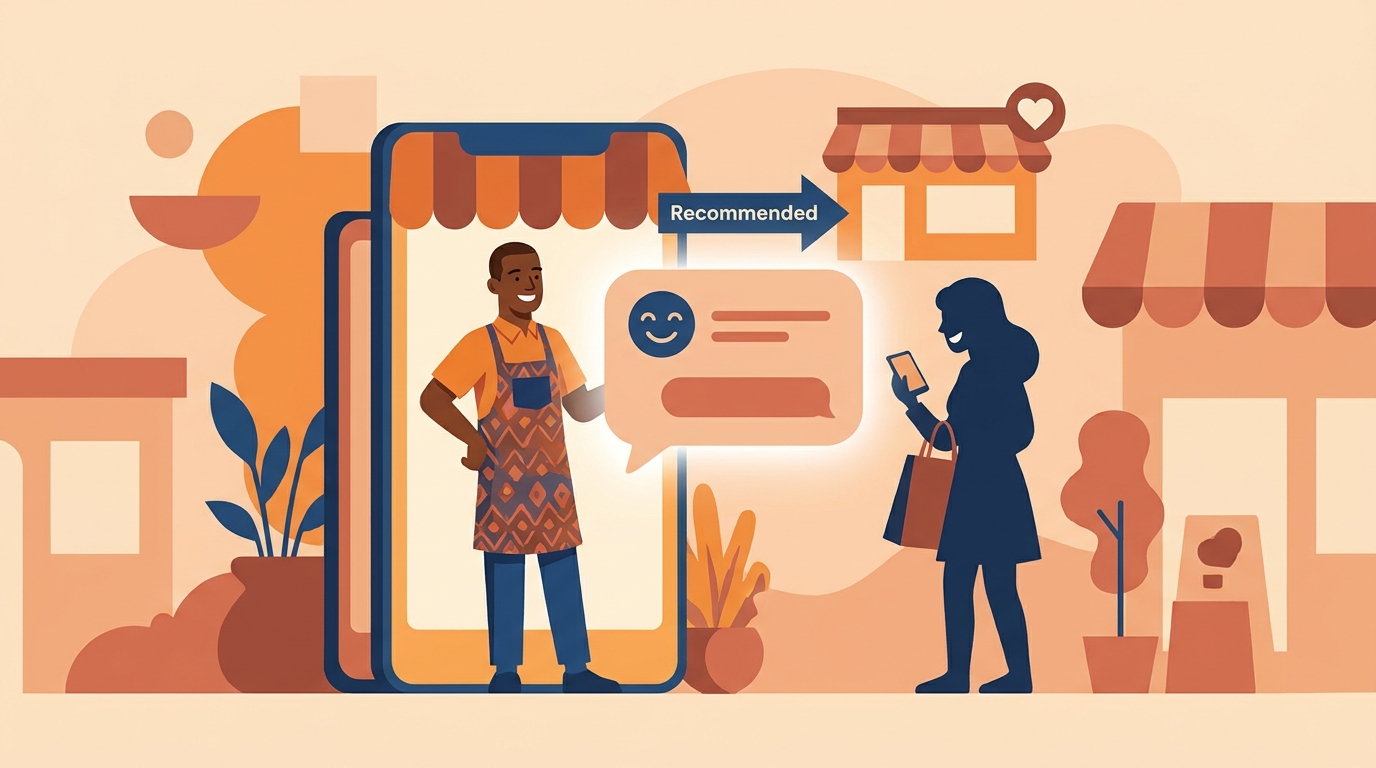
Third, start paying attention to a different number. For years we all stared at website traffic. Start also tracking how many people search for your business by name, and how many people mention that "an AI recommended you" when they call. That's the new word of mouth, and right now almost nobody is measuring it properly, which means you'll notice the shift before your competitors do.
The aspiration, stated plainly
If there's one habit I'd ask every founder and small business owner reading this to build going into next year, it's this: stop treating your online presence as something you set up once and leave alone. Review it the way you'd review your shop's shelves, regularly, honestly, and from a customer's eyes, not yours. The businesses that will struggle in this new era aren't the ones with the smallest budgets. They're the ones who assume the way customers found them in 2022 is still the way customers find them now.
We build and maintain business systems and websites for a living at Vapor, and this is one of those shifts where being early costs almost nothing, and being late costs more than people expect. You don't need a bigger marketing budget to adapt to this. You need to be willing to look honestly at how your business shows up when someone, or something, goes looking for an answer.
Steve Nyanumba
Building software for Kenyan and African businesses at Vapor Technologies.
Building something for your business?
We help Kenyan and African businesses ship software that performs.