Robots Have Always Stayed Behind a Fence. This Month, One Quietly Walks Into the Room
For sixty years, robots have stayed behind a factory fence. In August 2026, Tesla, BYD, Unitree, Chery and Xpeng are all racing to walk them out from behind it. Here's what's actually happening, what's still hype, and the one small habit worth starting this month.
In this article
On July 25th, a BYD showroom in Zhengzhou posted a teaser image. No specs, no price, no launch date beyond "August." Just one line: it won't show up with a pile of specs and jargon. Maybe when you walk closer, it moves slightly.
That's it. That's the whole announcement. And somehow it's one of the more interesting things I've read all year.
Here's why. BYD isn't a scrappy robotics startup trying to get attention. It's one of the largest car makers on the planet, and it just confirmed to a national business newspaper that this August, it's putting a humanoid robot in a public showroom, in front of ordinary people, off camera, without a script. Not a video. Not a stage demo at a tech conference with a safety cable carefully kept out of frame. A showroom. The kind of place you and I actually walk into.
I want to talk about why that small detail matters more than it sounds like it should, what's actually happening behind it, and the one habit worth building now, long before any of this reaches Kenya.
The fence is coming down
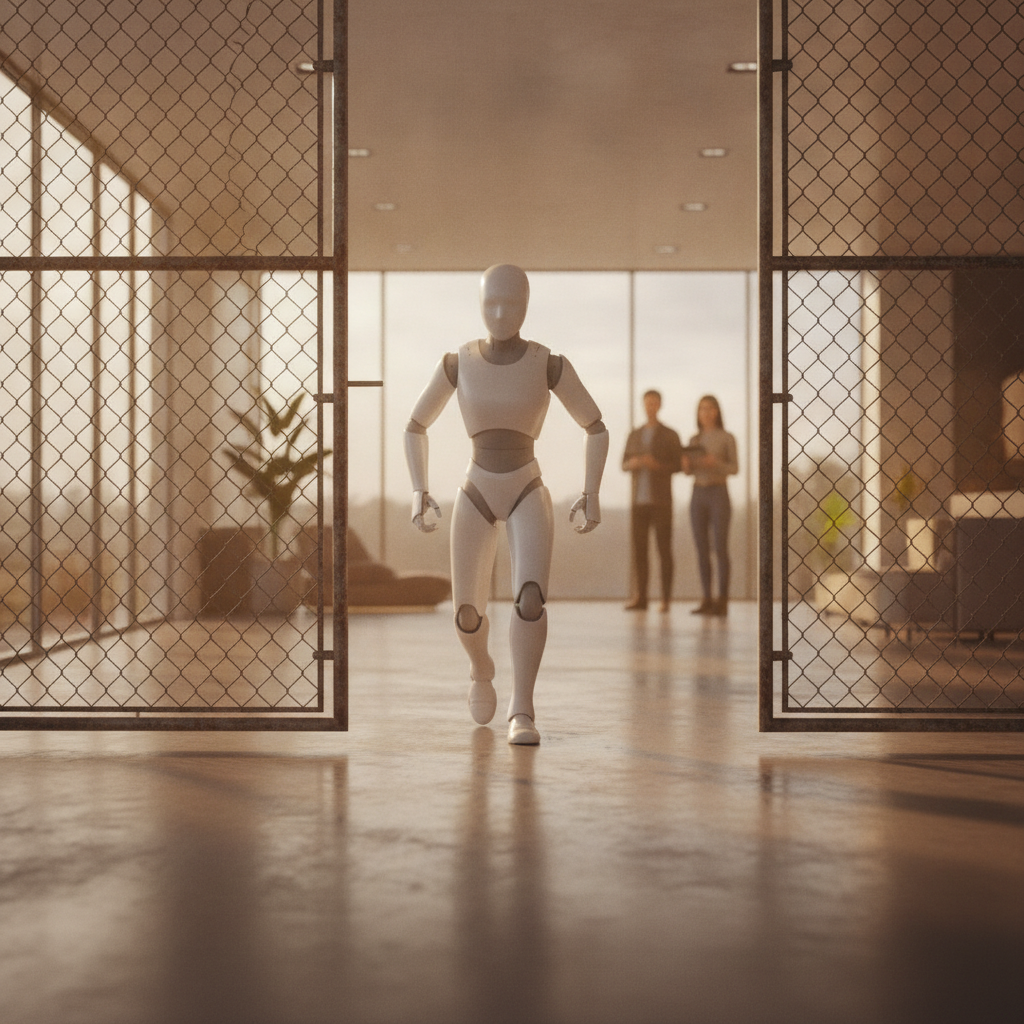
For as long as robots have existed on factory floors — and that's over sixty years now — they've lived behind a fence. Literally, in most cases: a cage, a painted yellow line, a sensor that shuts the whole line down the moment a person steps too close. Industrial robots are strong, fast, and not particularly aware that you're standing next to them. The fence was never a design choice. It was a warning.
What's happening in 2026 is that several of the world's largest manufacturers are racing to build robots meant to come out from behind that fence — not to replace the arm welding car doors on the line, but to do something closer to what a person does: walk, carry, open a door, pick something off a shelf that was never arranged for a machine.
BYD is the newest name in that race, but it's far from the only one. Chery's Aimoga brand is already selling a humanoid robot directly to consumers. Xpeng has said it plans to mass-produce its own, called Iron, by the end of this year. Tesla has reportedly converted part of its Fremont factory — the very line that used to build the Model S and X — specifically to manufacture its Optimus robot, and is breaking ground on a dedicated factory for it in Texas. Supply chain reports suggest Tesla's production capacity could climb to roughly 2,500 units a week by year-end, with several hundred already ordered for delivery this August.
And in China, Unitree Robotics — a name most people outside the industry hadn't heard eighteen months ago — just had its stock exchange listing approved in 104 days, among the fastest approvals on record, at a company valuation of around $6.2 billion. Its shipment target for this year alone: 20,000 robots.
Read those numbers again, slowly. This isn't one company's marketing stunt. It's several of the most capital-rich manufacturers on the planet, independently, within the same few months, deciding this is the year robots stop being something you only watch from behind a fence.
Why this is happening now, in plain terms
Here's the part that actually connects to everything else I've been writing about this year.
The reason robots are suddenly getting good enough to walk into a showroom and react to a stranger approaching isn't that engineers finally hand-coded enough "if a person is near, do this" rules. Nobody could write enough rules to cover the millions of small, strange situations a body runs into just standing in a room. What changed is the same thing that changed with the AI already on your phone: instead of programming every rule by hand, these robots are trained on enormous amounts of real movement — video and sensor recordings of arms, hands and legs doing ordinary things — the same way a language model was trained on enormous amounts of text instead of grammar rules. The robot isn't following a script for "person approaches." It's drawing on a very large, very well-practised sense of what usually happens next, and improvising from there.
That's the same shift I wrote about back in July, when AI moved from just answering your questions to quietly doing the work for you. This is that exact same shift, wearing a considerably heavier body. First it learned to answer. Then it learned to act on a screen. Now it's learning to act in a room, with real weight and real momentum, near real people. Every step of this has felt sudden. None of them actually was.
The honest catch
Before this starts sounding like robots are landing in Nairobi next month — they are not, and I'd be doing you a disservice if I let you walk away thinking otherwise.
Most of what's genuinely working today is narrow. The real deployments happening right now, in actual warehouses and factories, are mostly single-task work: moving boxes from one conveyor to another, sorting items, loading a truck in a fixed, controlled space. That's useful, but it's a long way from "a robot that can do anything a capable person can do," which is still the dream everyone's chasing and nobody has actually delivered. A carefully lit showroom demo reacting to one visitor in a controlled setting is not the same claim as "reliable in your unpredictable, messy, real environment," and this industry has a well-earned habit of blurring that line in its own marketing.
Price is the other honest catch. Capable humanoid robots today range enormously — from toy-tier machines a few thousand dollars can buy, up past tens of thousands of dollars for anything close to what BYD, Tesla or their competitors are building — and that's before maintenance, and before you consider that a robot breaking down in your only warehouse is a very different problem than a laptop freezing on someone's desk. This is not a purchase decision for almost anyone reading this. Not this year, and probably not next year either.
A small habit, for this month
So if you can't buy one and shouldn't want to yet, what's actually worth doing with any of this?
Here's the tiny, doable version. This month, make a short list — on paper, in your notes app, wherever you actually keep things — of the repetitive physical tasks in your business or your home that you've always assumed were "safe," specifically because they involve hands and not screens. Restocking shelves in the same pattern every morning. Moving the same boxes from the same corner to the same shelf. Sorting, folding, fetching, cleaning a fixed space the same way, every single day.
That's the whole habit. You're not deciding to automate anything. You're not buying equipment. You're building the same muscle the sharpest business owners already built for digital work over the last couple of years: noticing where the repetition lives, before someone or something else notices it for you. When this change reaches this far — and gradually, unevenly, eventually, it will — the person who already has that list written down will move a lot faster than the person seeing it for the first time.
Where I actually land on this
I'll be honest about where I sit. I don't think a humanoid robot is coming to run your shop counter in Nairobi or Mombasa anytime soon, and I'd be selling you a story if I said otherwise. What I do think is that the pattern underneath it — AI moving off the screen and into the physical world, the same way it moved from answering to doing on your phone — has not once, in the last two years, stayed a "someday" story for as long as people expected it to.
A BYD showroom in Zhengzhou is a long way from a hardware shop in Ngara. But eighteen months ago, so was a computer that could write working code from a plain English sentence. I'm not telling you to get excited about robots. I'm telling you to keep the fence in mind, and notice, calmly, when it starts coming down somewhere near you.
Steve Nyanumba
Building software for Kenyan and African businesses at Vapor Technologies.
Building something for your business?
We help Kenyan and African businesses ship software that performs.